
| Worth seeing: | for the warmth of the children that gets lost in the cruelty that follows as hope gives way to bitterness |
| Director: | Emerald Fennell |
| Featuring: | Jacob Elordi, Margot Robbie, Alison Oliver, Amy Morgan, Charlotte Mellington, Ewan Mitchell, Hong Chau, Martin Clunes, Owen Cooper, Shazad Latif, Vy Nguyen |
| Length: | 136 minutes |
| Certificate: | 15 |
| Country: | UK, US |
| Released: | 13th February 2026 |
WHAT’S IT ABOUT?
Yorkshire landowner, Mr Earnshaw (Martin Clunes), is well past his best – an alcoholic gambler, bringing up his daughter Catherine (Charlotte Mellington) with a young housekeeper, Nelly (Vy Nguyen). One day, he brings home a street urchin (Owen Cooper), to try to offer him a better life – not that he really has the capacity to do so anyway. The boy is unable to speak, so Catherine decides to name him Heathcliff, after her dead brother.
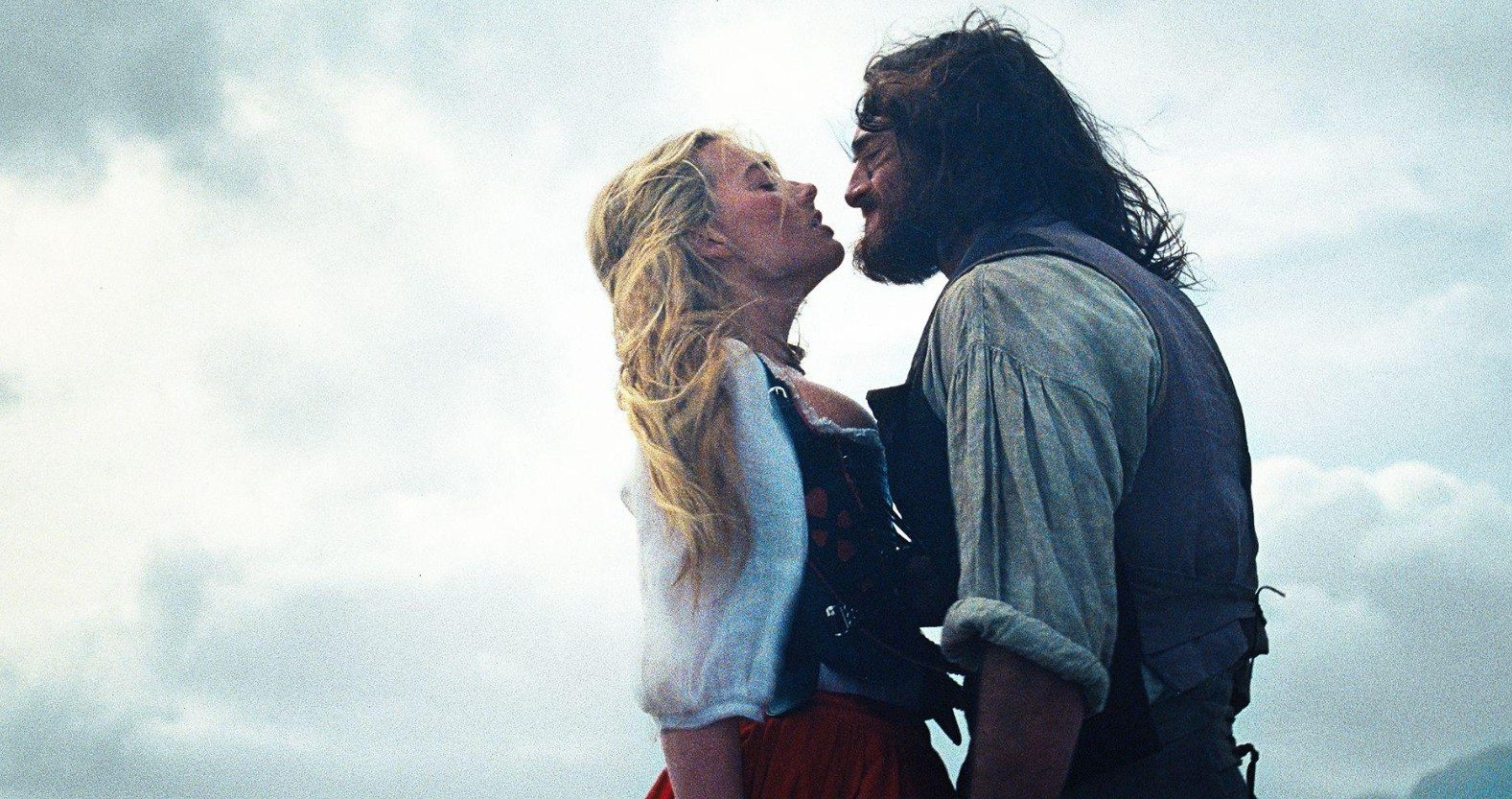
Over the years, Catherine and Heathcliff become close and vow that they will always be there for each other. As adults, the pair (now played by Margot Robbie and Jacob Elordi) are clearly attracted to each other, but Catherine wants to marry up the social ladder and gets excited when a wealthy man, Edgar Linton (Shazad Latif) moves into the neighbouring villa with his young sister, Isabella (Alison Oliver).
When Heathcliff overhears Catherine telling Nelly (by now, played by Hong Chau) that she’s agreed to marry Edgar, as Heathcliff is too low status for her, he runs off – missing the bit about her still truly loving Heathcliff. He disappears to try to make something of himself and by the time he returns a wealthy man, taking over Wuthering Heights from a sickly and ageing Mr Earnshaw, Catherine has long since married Edgar.
But the attraction between them remains irresistible and Catherine and Heathcliff can’t keep their hands off each other. But when it’s clear that she won’t leave Edgar, he starts flirting with Isabella, all the while making it clear to Isabella that he’s only trying to make Catherine jealous. Nelly, meanwhile, does her part in ensuring that this love story is not going to have the ending that either of its protagonists might once have hoped for.
WHAT’S IT LIKE?
Like the 2011 adaptation of Emily Brontë’s classic novel by Andrea Arnold, Emerald Fennell’s stops midway through the book, presenting us with only one generation of familial rivalries, rather than two. Fennell also cuts out an entire character – Cathy’s brother Hindley – leaving Mr Earnshaw to do the heavy lifting. None of this makes it any less dramatic or worthwhile, but fans of the source material might feel short-changed. That said, Fennell herself uses “quote marks” to enclose the title of her film, as a sign that she’s not taking the original text too literally.
Which is just as well, as she takes other liberties too – the novel variously refers to Heathcliff as being like a “gipsy,” “dark skinned,” like an Indian sailor or even having something to do with slaves; Andrea Arnold depicted him as black, but Fennell uses her Saltburn star Jacob Elordi, and gives him a thick Yorkshire accent, even though the book suggests that Mr Earnshaw found him in Liverpool. Diversity comes to Fennell’s film through her colour-blind casting of Hong Chau as Nelly and Shazad Latif as Mr Linton.
The early years of Catherine and Heathcliff’s friendship are the warmest – the innocence of childhood, paired with the generosity and vulnerability of the hostess and her guest deliver some beautiful moments, but once Robbie and Elordi take over the roles, the warmth is replaced by greed, selfishness, jealousy, infidelity and vindictiveness, all the while with unbridled passion lurking in the shadows.
Despite the “romance” tag and the steamy looks in the poster, “Wuthering Heights,” is not your typical Valentines Day film. At its heart, it’s more tragedy than romance, with more hatred and bitterness beneath the surface than there is love, which ultimately makes for a strange relationship between the viewer and the protagonist – we’re being asked to root for a pair of shallow, underserving losers, while they both do whatever they can to upset each other – and both of the Lintons, neither of whom have done anything to deserve the cruelty that’s thrown their way.
Fennell’s stylised production design effectively distinguish between the relative hell of the dingy Wuthering Heights that everyone is trying to escape and the pristine, bold and brightly decorated villa that Catherine covets. The costumes – perhaps too obviously – represent the financial status of the characters.
The entire plot hinges on one decision made by Catherine – the wrong decision for the wrong reasons – and from this point, the audience is led on a wicked ride. It often feels pointless to offer them your goodwill, because you can be sure they’re going to reject it as their spiralling rivalry leads them to cut off their own noses to spite their faces.
It becomes a nihilistic narrative, often beyond the control of the characters, but even where they do have control, they seem to make their decisions based on what will hurt the others, rather than what might bring themselves happiness. And the one character who seems to hold the key to everything – the housemaid Nelly, who narrates the book but simply observes here – doesn’t seem to have any motivation to want to upset everyone she ends up upsetting.
It’s not really unrequited love when what’s standing in the way of happiness is your own stupid behaviour. But perhaps that’s the point? You often upset the people you truly love the most – and there’s often no logical reason for your destructive behaviour.
Fennell is in the peculiar position where, having chosen to adapt a novel, she can’t be blamed for any failures in the narrative – but she chose to adapt this story and, in her case, she has also made certain decisions to ignore or change parts of the source material that don’t fit the tale she wants to tell.
Another key creative here is Charlie XCX, who provides some original songs for the soundtrack. Some fit the material well, but others jar in a way that will forever pin this adaptation of an early 19th century story firmly in the 2020s. So, unlike with a film that uses timeless classical music or songs that fit the timeframe of the story, anyone watching this period piece in decades to come could find the soundtrack unusually disorientating.
So, while it’s a beautiful film, tightly scripted and well performed, with some clever touches – and some irritating ones, it’s passionate but pointless, nihilistic and cruel, with few moments of levity or joy. Whether that’s down to Emily Brontë or Emerald Fennell, it’s hard to tell.
This is not a Valentine’s Day release that will have you bouncing out of the cinema with a spring in your step, your hand in your partner’s and a positive outlook about your future together.