
| Worth seeing: | if you're more interested in a conspiracy thriller than a magical mystery about aliens. |
| Director: | Steven Spielberg |
| Featuring: | Colin Firth, Emily Blunt, Josh O'Connor, Brandon Wilson, Colman Domingo, Courtney Grace, Elizabeth Marvel, Eve Hewson, Gabby Beans, Henry Lloyd-Hughes, Hettienne Park, Jeremy Shamos, Priyanka Kedia, Tommy Martinez, Wyatt Russell |
| Length: | 145 minutes |
| Certificate: | 12A |
| Country: | US |
| Released: | 10th June 2026 |
WHAT’S IT ABOUT?
Young computer scientist Daniel Kellner (Josh O’Connor) has disappeared from the secret government agency he works for, Wardex, and gone on the run with his girlfriend Jane (Eve Hewson) and a back-pack full on thumb-drives containing secrets that will change the world if they reach the public.
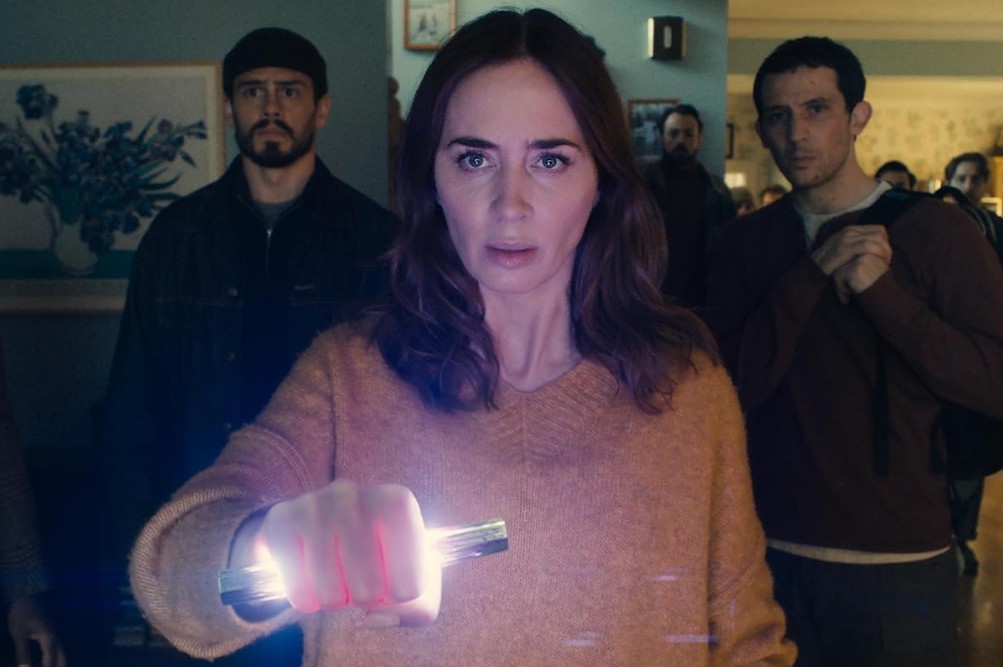
Maggie (Emily Blunt) is a Kansas City TV weather presenter with dreams of becoming a news anchor. After a small red bird flies into her apartment, she starts speaking in tongues and develops a gift for mind-reading.
When she has an outburst on live TV, making unintelligible clicking sounds during a forecast, Wardex split their resources between trying to catch Daniel and bringing Maggie into custody.
As the head of Wardex (Colin Firth) and his paramilitary gang of enforcers draw closer to them both, another defector, Hugo (Colman Domingo), is making preparations to help Maggie understand what’s happening to her and to help Daniel reveal his secrets to the world.
WHAT’S IT LIKE?
A new film from Steven Spielberg is always an event – especially when he revisits some of the ground that helped him secure his reputation as one of the world’s greatest story tellers. With a score reminiscent of ET and aliens straight out of Close Encounters of the Third Kind, he’s reaching for his greatest hits, but he falls short – not least because the aliens, on this occasion, are almost an afterthought.
You’ll be told this is a film about aliens – but it’s more accurate to think of it as a conspiracy thriller.
There are car chases, speeding trains, private armies mostly running around or staring at computer screens and a handful of glowing maguffins – but while we see their technology in action, we hardly seen any aliens at all, and when we do, they’re largely just on a screen, so you don’t get the same emotional attachment or aspirational wonder you have with ET, for example.
It’s not quite clear what made Daniel go rogue and decide he needed to disclose evidence that aliens have visited earth – and through no fault of their own, might have ended up staying longer than they’d expected – but you can imagine that those trying to keep the secret might do everything in their power to stop him. But if he’s the world’s greatest computer geek, is he going to be running around with a bag full of thumb-drives? Wouldn’t he have just stored the data in the cloud somewhere – or even leaked it from the outset?
Such anachronisms make you a little weary – it’s set in the modern day, they even reference AI just to let us know – yet when a key narrative moment, in reality, would be dismissed as AI, it’s accepted without question as the truth. As someone’s whose “day job” is in new broadcasting, the idea that anyone would simply accept what someone else is broadcasting as truth and run-with it before checking is more unlikely than the idea that the authorities are hiding evidence of alien visitations in the first place.
And of all people, Spielberg should know this – he knows how news works – he made The Post, after all. In some senses, this could have been a more successful narrative had it been set before the age of AI – or smartphones – or even before the internet. Had this been a follow-up to Close Encounters or ET, how much more authentic it would have felt.
And the consequences of Maggie’s encounter with the little red bird clearly leave the audience wondering how she’s connected to it all. But until her past comes back to haunt her, no-one – not even Daniel’s fellow rogue agents, who’ve clearly been planning “Disclosure Day” for some time – would have known she was in any way linked to what was about to happen, which makes the plan to head to her TV network HQ all the more inexplicable. And if they did know her back story, and her past had already been awoken, why would they have needed to go through everything they were going through to help her awaken her backstory. Furthermore, had the child with the unrealised gift from beyond our planet not gone on to become a TV broadcaster, how on earth would Wardex’s rogue agents have released their secrets?
There are some interesting ideas to be discussed – such as a potential conflict between faith in God and the knowledge that humans are not alone in the universe he created – and the notion that the President of the United States can be left out of the loop on major decisions as he’ll be a civilian again in a maximum of eight years – but the fundamental heart of the narrative is less convincing. The whole film seems to be built on the premise that the public must be protected from the truth at all costs – even to the extent that Wardex is prepared to kill people to protect the public from themselves – but when Disclosure Day is finally realised, the only real-world impact we see is that people miss the bus because they’re too busy looking at their phones to notice it’s arrived at the bus-stop. There are no riots. No chaos. Civilisation doesn’t collapse. Perhaps THAT’s the point of his film? Maybe he’s trying to say that we CAN cope and there’s NO need to hide the truth from us?
One of the big problems of these conspiracy theories about the Americans having physical evidence of alien visitations is that as unlikely as it is that we are the only inhabited planet in the universe, it’s similarly unlikely that if any other extraterrestrial life-forms might have visited us in our planetary history, we would be aware of only one – and if only one set of aliens had ever visited, why are these two millennials the only ones to be imbued with knowledge and abilities that may or may not even have been acknowledged or used.
ET told the story of one boy befriending one left-behind alien; Close Encounters ultimately followed large numbers of people who were picking up a sense that something bit was about to happen; Disclosure Day is less a film about getting to know aliens and discovering what we could learn from them than it is a bunch of humans running from another bunch of humans who want to stop the first bunch broadcasting some computer files – for most of the film, it doesn’t really matter what’s on the files; there are car chases, paramilitaries doing whatever Colin Firth tells them to – and on the few occasions that we do see aliens or their craft, it’s mostly historical footage on screens, so we don’t get to share in the wonder of watching the characters experiencing it for themselves.
A lesser story-teller might be forgiven some of the missteps of Disclosure Day, but Spielberg’s history means he can – and should – be held to a higher standard. He knows how to captivate audiences and manipulate their emotions, but rather than taking this audience on a magical journey of imagination, this time, he resorts to using cinematic short-hand and the conceits of thrillers to trick the audience into feeling captivated and manipulated. While there’s lots to think about, the more you think about it, the less the plot itself hangs together and the less convincing it becomes.
While it’s verging on being a little too long, it’s rarely short of being entertaining but it has nothing of the intellectual heft or emotional draw it seems to think it has. Spielberg has had nearly fifty years – since first bringing aliens to Earth in Close Encounters – to think about what might have happened to them, and this is his answer? It’s disappointing that Spielberg – of all people – chose such a potentially fascinating subject but then dropped the ball.