| Worth seeing: | for a strong performance from Rose Byrne as an unsympathetic mother in a nihilistic drama whose true meaning the director wants viewers to work out for themselves |
| Director: | Mary Bronstein |
| Featuring: | Rose Byrne, A$AP Rocky, Christian Slater, Conan O'Brien, Danielle Macdonald, Delaney Quinn, Josh Pais, Mark Stolzenberg, Mary Bronstein, Ronald Bronstein |
| Length: | 113 minutes |
| Certificate: | 15 |
| Country: | US |
| Released: | 20th February 2026 |
WHAT’S IT ABOUT?
Linda (Rose Byrne) is struggling to care for a daughter with a debilitating eating disorder, with the doctors threatening to withdraw their support if she fails to cooperate. To add to her problems, her husband Charles (Christian Slater) – a military man – is away from home – a home that’s falling apart – literally.
Linda’s regular sessions with her therapist (Conan O’Brien) don’t seem to be helping her get a grip of her issues; a therapist herself, her inability to control her own situation results in her increasingly failing her own patients, even more emotionally fragile than Linda herself – if that’s even possible.
When her home becomes inhabitable, Linda and her daughter move to a motel, where her new neighbour, James (A$AP Rocky), is intrigued enough in the new arrival to try to befriend her – but Linda is in no position to pursue anything approaching a regular friendship.
The sicker her daughter becomes, the more stress is heaped onto a woman who is already finding it almost impossible to hold herself together, with the pressure of parenthood and a responsibility to her patients, sending her into a downward spiral of physical and emotional self-destruction.
WHAT’S IT LIKE?
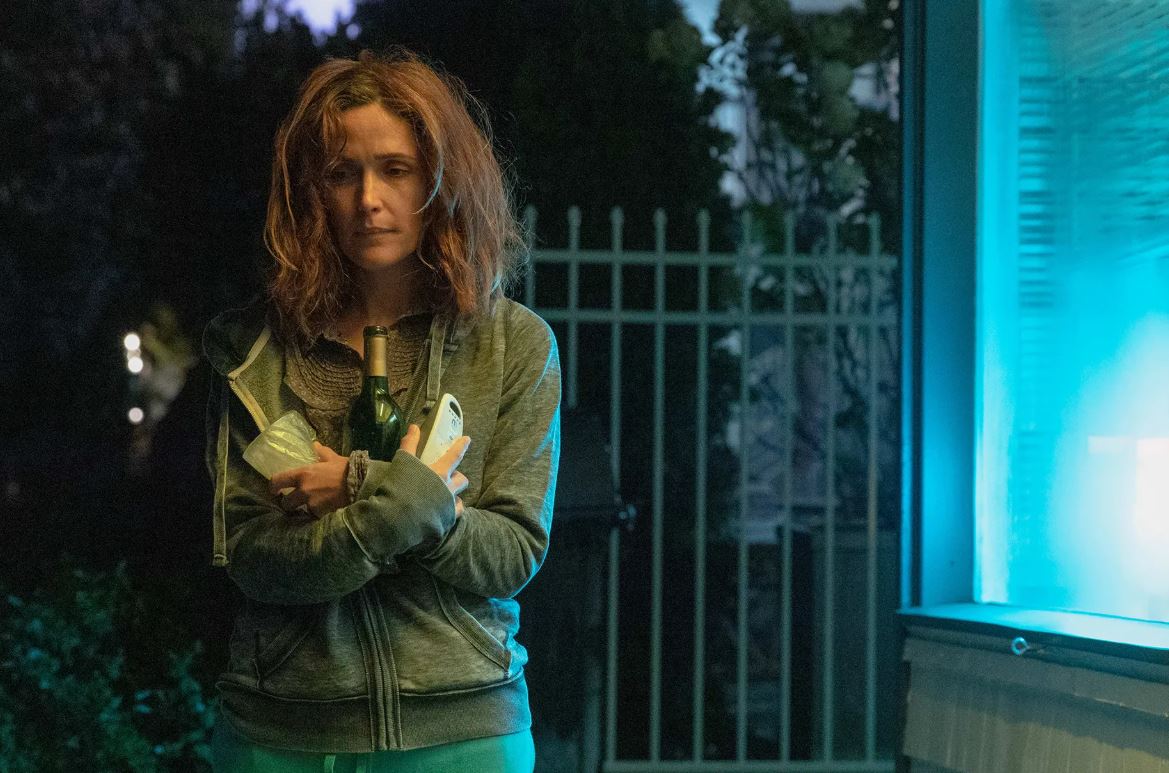
For the entire first scene of Mary Bronstein’s disturbing psychological drama, a close-up on Rose Byrne’s distressed face sets the scene for what is to come, but while it initially feels like the whole narrative will unfold with its protagonist in close-up, the camera soon opens up to show everyone as you would expect – well, almost everyone; her daughter remains unseen – like a cancer, eating away inside her.
Several reasons have been given for Bronstein’s unconventional decision not to show what her protagonist would see as the constant, oppressive thorn in her side – it’s been suggested that seeing the daughter would have increased sympathy for her and turned people away from Linda, but if anything, the opposite seems to be the case – hearing the pained cries of the child and the dismissive way in which Linda responds makes this troubled mother’s behaviour all the more disturbing.
It’s an odd decision to ask the audience to be rooting for someone so clearly guilty of child neglect – a selfish mother with no maternal instincts – riddled with psychological problems. That Rose Byrne is able to emerge with an ounce of sympathy is a reflection of a remarkable performance, that’s being recognised with nominations and trophies this awards season.
More engaging directing decisions include a number of scenes where Linda’s discomfort takes her into the realms of fantasy – and there are some darkly comic moments, a particularly memorable one involving a hamster.
But watching the emotional decline of an already fragile woman feels disappointingly nihilistic and while we can all appreciate how difficult her life is, you feel you just want to shake her, slap her in the face and tell her to get a grip of herself. Perhaps that’s the point?
The title itself is one of the most intriguing elements of the film – but while it might bring up a sense of helplessness in the protagonist, Bronstein herself has revealed that it was a phrase that occurred to her as a teenager and popped back into her mind when she was writing this film and couldn’t decide what to call it. She even goes so far as to say that it’s up to viewers to decide for themselves what they think it might mean.
This seems to be an easy – lazy – retort from an auteur who doesn’t completely understand their own work or isn’t particularly clear about the message they want the viewer to leave the cinema with. It’s all very well to say that an element of art is about the perception of the consumer but is it a complete work of art if the creator claims not to know what it means and wants the viewer to decide what it means for themselves – or doesn’t care that the viewer might not understand. Who, then, is actually creating the art – or creating meaning for the art?