
| Worth seeing: | to share the experience of watching Hamlet for the first time with William Shakespeare's wife |
| Director: | Chloé Zhao |
| Featuring: | Jessie Buckley, Paul Mescal, Bodhi Rae Breathnach, David Wilmot, Emily Watson, Jacobi Jupe, Joe Alwyn, Noah Jupe, Olivia Lynes |
| Length: | 126 minutes |
| Certificate: | 12A |
| Country: | UK, US |
| Released: | 9th January 2026 |
WHAT’S IT ABOUT?
In late 16th Century Warwickshire, Will (Paul Mescal) is teaching Latin to pay off his father’s debts. He meets and falls for Agnes (Jessie Buckley), the enigmatic the elder step-sister of his pupils.
When she becomes pregnant, the pair marry, against the wishes of both of their families. By now, Will is working as a manual labourer for his father’s glove factory but he really wants to become a playwright.
Agnes agrees that Will should move to London to pursue his dream, but she decides to stay in Stratford with their daughter – and the twins, Hamnet an Judith, who arrive shortly afterwards.
Will’s long absences put a huge strain on family life and he’s not around when his son, Hamnet (Jacobi Jupe) succumbs to the plague. The tragedy puts further pressure on his relationship with Agnes, even as his growing success in London enables him to buy the biggest house in Stratford.
Some time later, accompanied by her brother (Joe Alwyn), Agnes heads to London for the premiere of Will’s play, Hamlet – which we’re reliably informed is a name that was, at the time, interchangeable with Hamnet.
Sharing the tragedy with a huge audience at the Globe gives Agnes a sense of catharsis that she’s been looking for since the death of her son.
WHAT’S IT LIKE?
It’s not until Agnes arrives in London, looking for her husband, that we are formally told that he’s William Shakespeare – his name isn’t even heard before this – and with her being known as Agnes, rather than Anne, they further try to obscure the identity of the protagonists, perhaps for dramatic purposes ahead of the big reveal, perhaps so as not to distract from the story. But, of course, with the entire premise of the film – based on Maggie O’Farrell’s novel of the same name – supposedly being that Hamlet was in some way inspired by the death of Shakespeare’s only son, we know who we are watching from the start.
We are ostensibly following arguably history’s most influential playwright as he develops from a glove-maker to achieve his true potential – having to leave the bosom of his family, to head to London alone, to do so. Except that we don’t see him doing much writing – apart from some frustrated scribbling in his bedroom – and we get little sense of his growing success.
With any other set of characters, what we would actually be watching would be a young man and a young woman falling in lust, against the wishes of their respective families, having three children, but the father being largely absent, to enable him to build a career that he cannot do from rural Warwickshire; a perfectly valid story – not particularly original, but a perfectly serviceable drama.
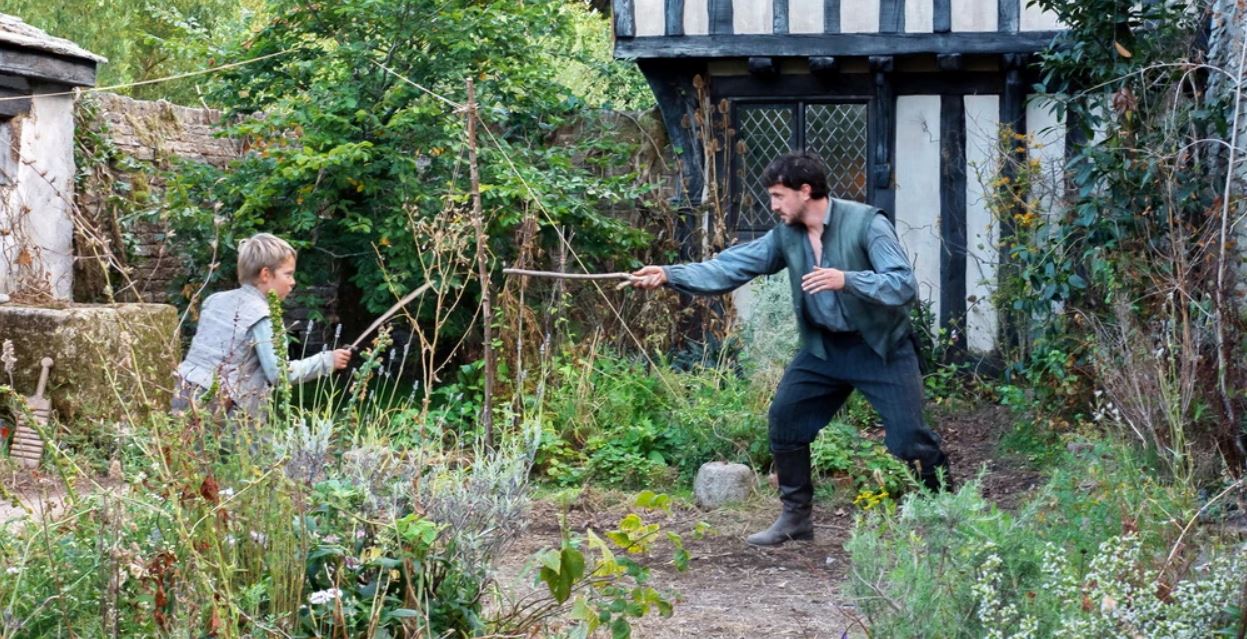
After a slow start, the narrative kicks up a gear when the family is struck by the plague and Will’s absence just makes Agnes feel that he’s abandoned her to bring up the children alone. But he’s not entirely absent – we see the occasional moment of father-son bonding, such as Will training Hamnet in the art of stage combat, as his son looks forward to one day joining his father in the theatre.
By now, Will’s periods of absence are at least mitigated by the fact that his family – particularly his mother (Emily Watson) – is fully behind the marriage and supportive of Agnes and the children. But this doesn’t stop Agnes giving Will a piece of her mind when he returns, too late to say goodbye to his son. This scene will doubtless provide most of the heavy drama clips that will deservedly appear in the awards ceremonies.
But it’s the denouement – Agnes’ visit to see Will’s play at the Globe – where the film finally comes to life. At last, she sees what he’s been working on. She finally understands that he too has been grieving for their son, in his own way. Seeing the reaction of the rest of the audience, she realises that through his words, he has made complete strangers understand her pain.
Hamlet, however, is not the story of a man who is grieving the loss of a son he has spent too little time with. It’s Shakespeare’s take on a popular Danish legend of Prince Amleth – even the name is predetermined by the existing story and to suggest even that he named his tragedy after his own son weakens the narrative, rather than strengthens it.
For a film that purports to be about how tragedy in his life inspired a tragedy on the page and stage, there’s an awful lot of screen time taken up by the couple’s meeting, early courtship, arrival of their first child and the early years of the twins – all of which bear little, if any, relevance to the writing of Hamlet. Most Shakespearean scholars believe there is as much autobiographical content in any of his other plays as there is in Hamlet – and in those days, that wasn’t much anyway.
Forget about the similarity of the names – affirmed as early as the opening title card – don’t settle in to watch a film about the writing of Hamlet – just see this as a powerful drama about the struggles of a young couple to overcome problems resulting from their families, their ambitions and the general poor standards of living in late 16th Century England – a young couple who just happen to be named Will Shakespeare and Agnes Hathaway.