
| Worth seeing: | for some fizzing dialogue, holding together a complex web of misunderstandings, that takes a little too long to get you to its inevitable conclusion |
| Director: | Georgia Oakley |
| Featuring: | Daisy Edgar-Jones, Esmé Creed-Miles, Frank Dillane, George MacKay, Bethany Slater, Bodhi Rae Breathnach, Caitriona Balfe, Ceara Coveney, Chloe Pirrie, Eliot Sumner, Fiona Shaw, Forrest Bothwell, Herbert Nordrum, James Carcaterra, Stacy Martin, Tom Brooke |
| Length: | 132 minutes |
| Certificate: | U |
| Country: | UK |
| Released: | 25th September 2026 |
WHAT’S IT ABOUT?
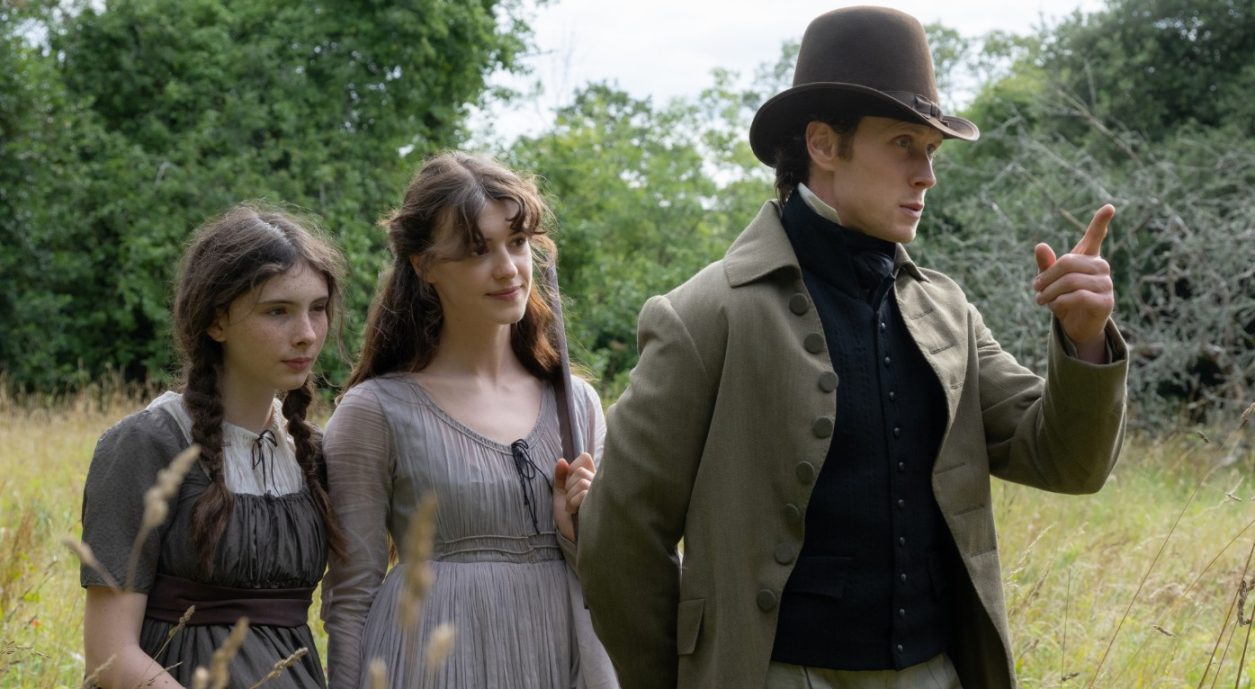
In late 1700s England, Henry Dashwood dies, leaving the house where his wife (Caitríona Balfe) and three daughters live to his son from a previous marriage, John (Tom Brooke). Henry wanted John to support his family, but John’s wife Fanny (Stacy Martin) has other ideas and Mrs Dashwood and her daughters are forced to move to a cheap cottage in Devon.
But not before a visit from Fanny’s brother Edward (George Mackay) ignites a flame in the heart of the eldest daughter, Elinor (Daisy Edgar-Jones). The pair continue to write to each other, but the distance seems to have extinguished the flame.
Meanwhile, the middle daughter, teenaged Marianne (Esmé Creed-Miles) has fallen for a charming local cad, John Willoughby (Frank Dillane), while the older friend and neighbour, Colonel Brandon (Herbert Nordrum) pines longingly from the sidelines.
Through a series of miscommunications – whether well-intentioned, mendacious or unintentional – friendships and relationships are built and broken, as the complicated path of true love tries to find its way.
WHAT’S IT LIKE?
Most famously, Jane Austen’s 1811 debut novel was turned into a classic 1990s big screen romance, with Emma Thompson starring as Elinor – and winning an Oscar for the screenplay.
While Ang Lee’s adaptation – more than thirty years ago – interpreted the novel as an upbeat romance, Georgia Oakley’s retelling of the story has more serious undertones, darker in mood.
Soaked in brooding period authenticity, the narrative itself seems inevitable, even to people unfamiliar with the source novel or the earlier adaptation; it’s clear from the first time eyelines meet precisely who’s going to end up with whom, and it’s only people wilfully withholding useful information that makes it take so long to end up exactly where you know it’ll end up from the start. In that sense, in a nod to another of Daisy Edgar-Jones’ most famous roles, it’s a bit Normal People.
The performances perfectly highlight the differences in character between the sisters and their suitors and the screenplay fizzes with phrases so eloquent that even though many are perhaps too clever for the characters uttering them, they make you wish you could pause the film, wind it back and listen to them again.
One slightly sour note – is the idea of a thirty five year old military man falling for a sixteen year old – and viewers being invited to root for him as the most honourable option for her. This is clearly Jane Austen’s fault for demanding the same of her readers, who – 200 years ago – might have had different – well – sensibilities. But given that as recently as this week, sketches by David Mitchell and Robert Webb were removed from the internet because the material “no longer works today,” in these modern times, classic novel or not, it’s hard not to argue that 35 year old men grooming 16 year old girls “no longer works today.”