
| Worth seeing: | as a useful, if simplistic entry into the conversation of device use and cyber-bullying among children, through a set of Disney Pixar toys that have been with us for more than 30 years |
| Director: | Andrew Stanton |
| Featuring: | Joan Cusack, Scarlett Spears, Tim Allen, Tom Hanks, Alan Cumming, Annie Potts, Bad Bunny, Bonnie Hunt, Conan O'Brien, Craig Robinson, Ernie Hudson, Greta Lee, Jay Hernandez, John Ratzenberger, Keanu Reeves, Kristen Schaal, Krys Marshall, Mykal-Michelle Harris, Shelby Rabara, Tony Hale, Wallace Shawn |
| Length: | 102 minutes |
| Certificate: | PG |
| Country: | US |
| Released: | 19th July 2026 |
WHAT’S IT ABOUT?
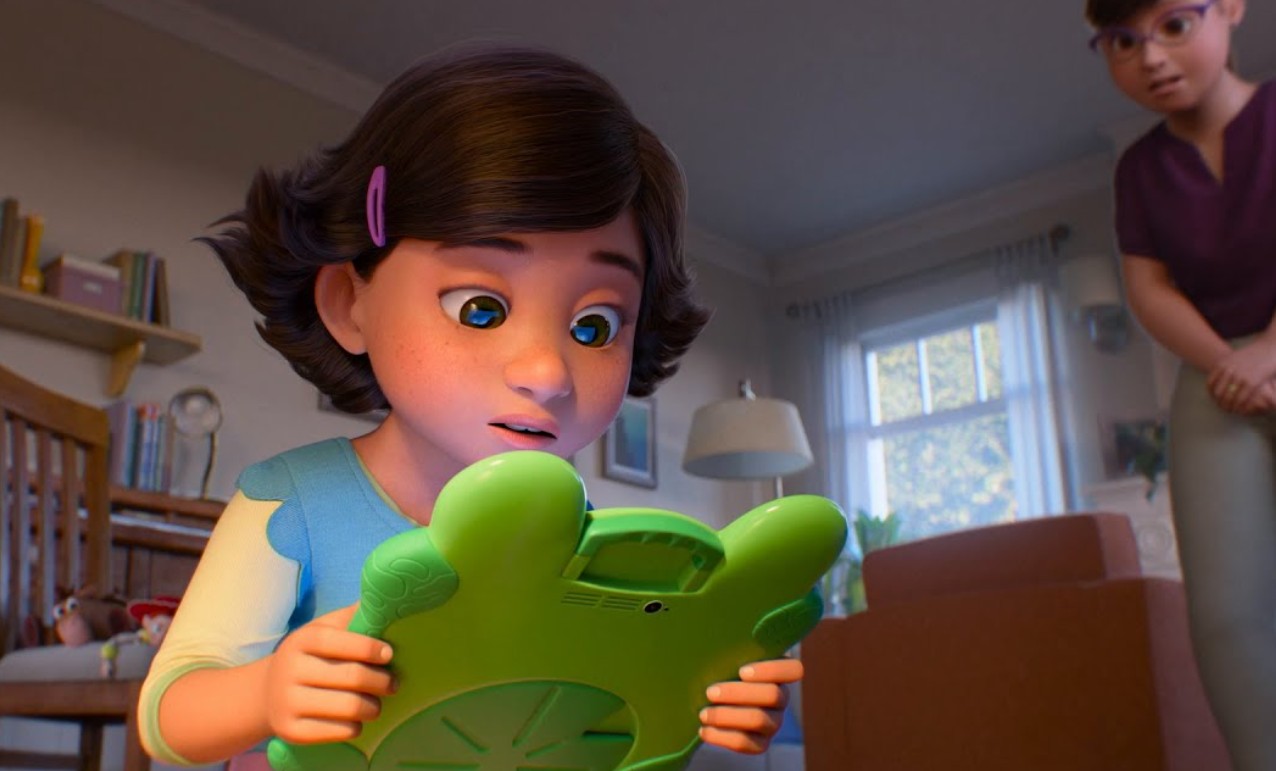
Eight year old Bonnie (Scarlett Spears) is upset that her new neighbours don’t want to play with her – it turns out the children are too busy on their devices to go outside to play.
So that she doesn’t feel too left out, Bonnie’s parents buy her a device of her own – a Lilypad (voiced by Greta Lee) – which searches for other children in online groups and “friends” them on her behalf.
Soon, Bonnie is spending all her free time with her online friends and her old favourite toys – including her pull-string cowgirl doll Jessie (Joan Cusack) and space ranger Buzz Lightyear (Tim Allen) – aren’t getting a look in.
Feeling neglected, Jessie sets off to find her original owner and ends up stranded at nine year old Blaze’s (Mykal-Michelle Harris) house, with her toys, including a handful of electronic devices.
While initially wary of the devices, Jessie realises they can help her contact Bonnie to let her know where she is – but when Bonnie turns up to reclaim her, she’s conflicted about whether to take her back, because her new “online” friends don’t play with toys anymore.
Can Jessie get Bonnie to play with real toys again? And even better, can she get her to play with Blaze?
WHAT’S IT LIKE?
Each instalment of Pixar’s Toy Story franchise isn’t just telling us a story about toys – it has something to say about children – whether it’s their relationships with each other or with adults – or whether it’s about growing up – but every story revolves around, as the title suggests, the toys.
Woody, Jessie and the rest have – over the years – belonged to different children – and they’ve helped their children grow and understand the world around them – but it’s always them at the heart of the action, if not always the emotional arc and the underlying message.
Now, at a time when governments around the world are banning children from social media – or at the very least, limiting their access to devices – turning its gaze on electronic devices gives the franchise added poignancy and brings it right up to date. “Do children still need toys?” is the question at its heart. And the idealistic answer, of course, is a big Y-E-S.
But life isn’t that simple. To accept the benefits that electronic devices bring with them does not mean the abandonment of anything that doesn’t need to be connected – whether to the power mains or to the Wifi. And spending time online isn’t all about cyber-bullying and inappropriate behaviour.
In reality, it can be hard to strike the right balance between using modern connected devices for entertainment, education and communication – while also offering protecting against their overuse. And there’s also no question that unguided playing with old-fashioned toys is more creatively enriching than shooting monsters or seeking compliments on a new hairstyle. That sitting in front of a screen all day could lead to obesity, while running around outside keeps you fit seems to escape the film-makers completely.
We need to be careful not to throw the baby out with the bathwater. While the story is somewhat simplistic, young audiences will learn about the potential pitfalls of modern technology, through an exciting narrative about a group of toys rescuing their lost leader.
It’s not the strongest of the films in the franchise and feels – at times – like it’s concentrating more on the message than the narrative – but a handful of gags for the adults, about how the toys themselves – like the parents – are aging – keep the whole family on board throughout.
Using three decade old characters to argue that old-fashioned toys very much have their place at the heart of childhood is a nice tough and while the message is simplistic, it provides parents with a useful starting point for conversation.